
Introduction
With rising fuel costs and increasing pressure to adopt clean energy, Compressed Biogas (CBG) is emerging as one of the most promising business opportunities in India. If you’re planning to setup a biogas CBG CNG plant in Jabalpur, you’re already looking at one of the most strategically advantageous locations in Central India.
Jabalpur, located in Madhya Pradesh, offers abundant agricultural waste, dairy clusters, and municipal organic waste—making it ideal for a biogas plant Jabalpur setup. Government-backed initiatives like the SATAT scheme and GOBARdhan mission are further accelerating the growth of compressed biogas plant Jabalpur projects.
In this detailed guide, I’ll walk you through the complete step-by-step process—from feasibility to commissioning—along with real costs, approvals, subsidies, and insider tips based on industry experience. Whether you’re an entrepreneur, farmer, or investor, this guide will help you understand how to start a CBG business in Jabalpur successfully in 2026.
Why Jabalpur is Emerging as a CBG/CNG Hub
Jabalpur is rapidly becoming a hotspot for CBG plant setup Madhya Pradesh due to several local advantages:
Key Advantages
- Abundant Feedstock Availability
- Cow dung from rural belts (Panagar, Patan)
- Agricultural residues (wheat straw, paddy husk)
- Municipal solid waste from Jabalpur city
- Strategic Location
- Well-connected to industrial hubs
- Growing demand for CNG plant Jabalpur fuel supply
- Favorable Climate
- Moderate temperatures ideal for anaerobic digestion
- Lower heating costs compared to northern states
- Government Push
- Strong support under CBG subsidies Madhya Pradesh
- Active implementation of SATAT & GOBARdhan schemes
Insider Tip: Areas near dairy clusters or highways (NH-30, NH-34) offer better logistics and gas offtake opportunities.
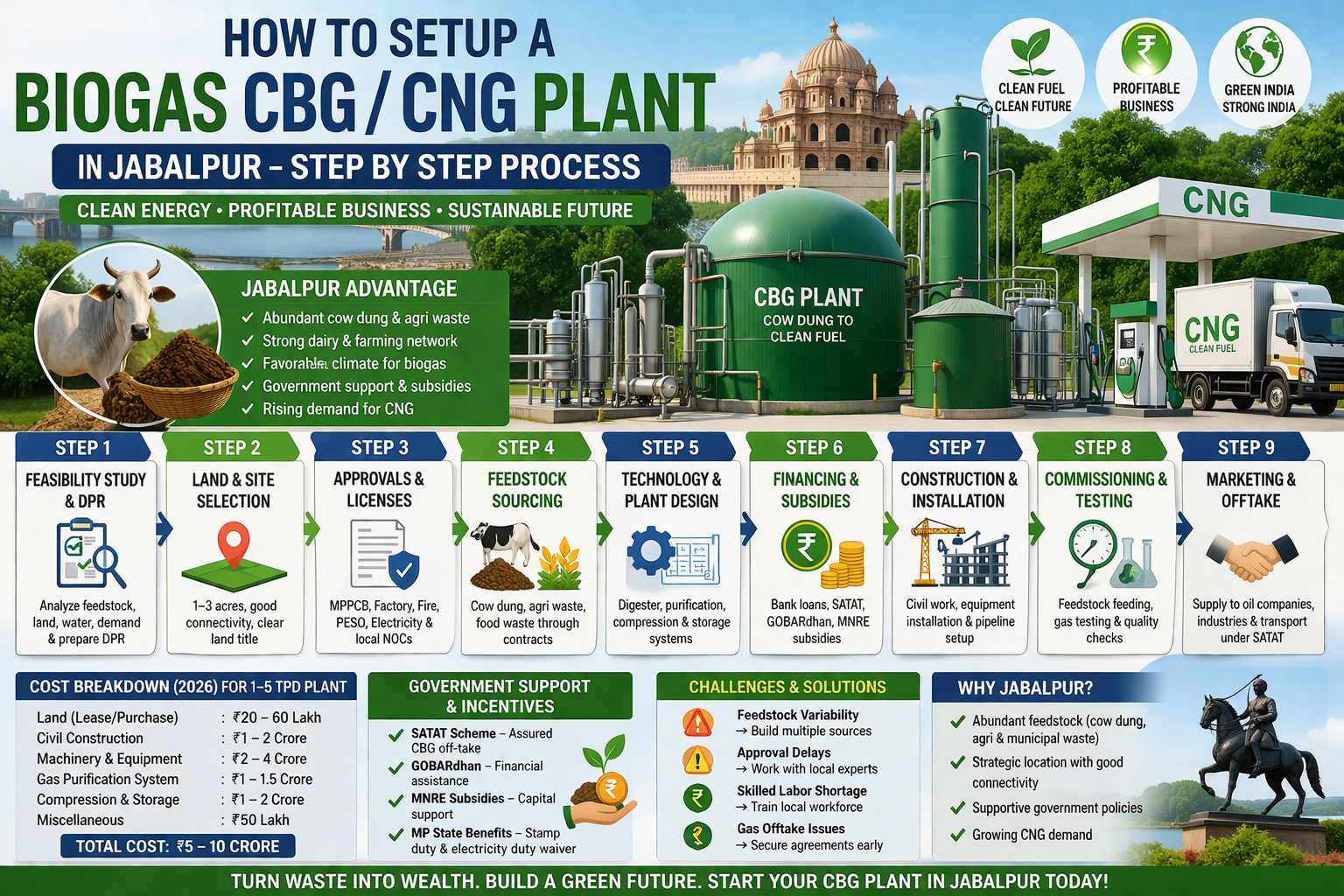
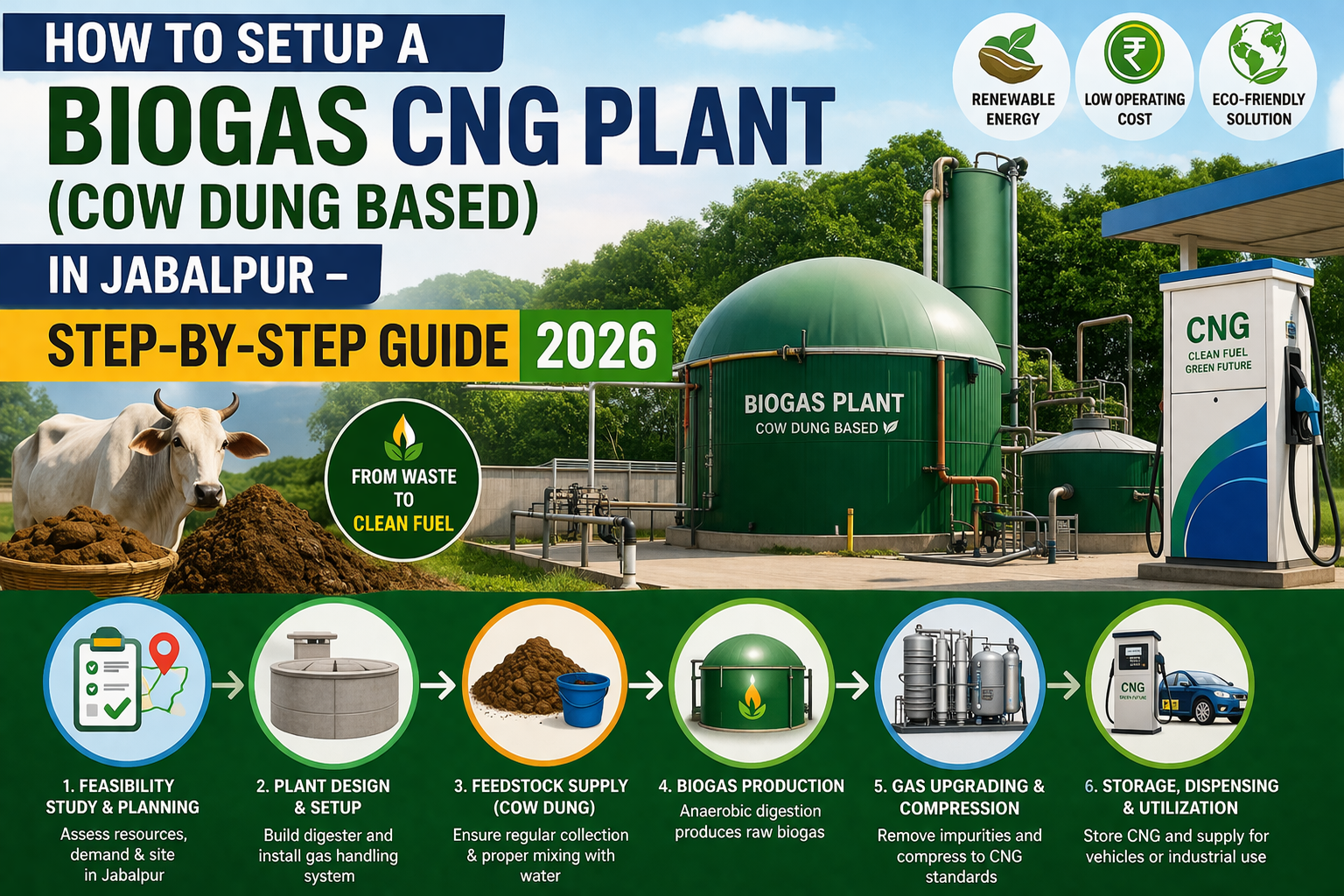
Step-by-Step Process to Setup a Biogas CBG / CNG Plant in Jabalpur
Step 1: Feasibility Study & DPR Preparation
Start with a detailed feasibility analysis:
- Feedstock availability (minimum 20–30 tons/day for small plants)
- Land suitability
- Water availability
- Market demand for CBG
Prepare a Detailed Project Report (DPR) including:
- Technical design
- Financial projections
- ROI analysis
Tip: Hire experienced consultants to avoid costly design mistakes.
Step 2: Land & Site Selection
Land is critical for a biogas plant Jabalpur.
Requirements:
- 1–3 acres for 1–5 TPD plant
- Away from residential zones
- Good road access
Ideal Locations:
- Rural outskirts (Panagar, Shahpura)
- Near gaushalas or farms
Checklist:
- Clear land title
- Non-agricultural conversion (if required)
- Water source nearby
Step 3: Required Licenses & Approvals
For biogas plant approvals Madhya Pradesh, you’ll need:
- Pollution Control Board (MPPCB) Consent
- Factory License
- Fire Safety NOC
- PESO approval (for gas storage)
- Electricity connection approval
- Local municipal permissions
Important: Approval timelines can take 2–4 months—start early.
Step 4: Feedstock Sourcing Strategy
Reliable feedstock is the backbone of a compressed biogas plant Jabalpur.
Common Feedstock Options:
- Cow dung (primary)
- Poultry litter
- Agricultural waste
- Food waste from hotels/mandis
Best Practices:
- Sign long-term contracts with farmers
- Offer collection incentives
- Set up aggregation points
Step 5: Technology Selection & Plant Design
Choose the right technology:
- Wet anaerobic digestion (for cow dung)
- Dry digestion (for mixed waste)
Key Components:
- Digester tanks
- Gas purification system
- Compression unit
- Storage cylinders
Tip: Work with proven vendors—cheap tech often leads to breakdowns.
Step 6: Financial Planning & Subsidies
To setup a biogas CBG CNG plant in Jabalpur, proper financing is essential.
Funding Sources:
- Bank loans (up to 70% project cost)
- NBFC financing
- Private investors
Key Financial Metrics:
- Payback period: 3–5 years
- IRR: 18–25%
Step 7: Construction & Installation
Construction typically takes 6–10 months.
Phases:
- Civil work (digester tanks)
- Equipment installation
- Pipeline & electrical setup
Tip: Monitor contractors closely—delays are common.
Step 8: Commissioning & Testing
- Initial feeding of biomass
- Gas production testing
- Quality checks (methane content)
Expected Output:
- 90–95% methane after purification
Step 9: Marketing & Offtake Agreements
Under the SATAT scheme:
- Oil companies buy CBG at fixed rates
- You can also sell to:
- Local industries
- Transport sector
Important: Secure offtake agreements before commissioning.
Detailed Cost Breakdown for a 1–5 TPD CBG Plant in Jabalpur (2026 Prices)
| Component | Estimated Cost (₹) |
|---|---|
| Land (lease/purchase) | 20–60 lakh |
| Civil construction | 1–2 crore |
| Machinery & equipment | 2–4 crore |
| Gas purification system | 1–1.5 crore |
| Compression & storage | 1–2 crore |
| Miscellaneous | 50 lakh |
Total Cost:
👉 ₹5–10 crore depending on scale
Note: Actual biogas plant cost in Jabalpur varies based on technology and land rates.
Government Subsidies, Loans & Incentives Available in Madhya Pradesh
Key Schemes
- SATAT Scheme
- Assured gas purchase by oil companies
- GOBARdhan Scheme
- Financial support for waste-to-energy
- MNRE Subsidies
- Capital subsidy for biogas projects
- MP State Policy
- Stamp duty exemption
- Electricity duty waiver
Loan Options
- NABARD financing
- PSU banks (SBI, PNB)
- Priority sector lending benefits
Tip: Combine multiple schemes to reduce capital burden.
Common Challenges in Jabalpur & How to Overcome Them
1. Feedstock Supply Fluctuations
Solution: Diversify sources and maintain buffer stock.
2. Approval Delays
Solution: Hire local consultants familiar with biogas plant approvals Madhya Pradesh.
3. Skilled Labor Shortage
Solution: Train local workforce during construction phase.
4. Gas Offtake Issues
Solution: Secure long-term agreements early.
Success Stories & Real Examples Near Jabalpur / Madhya Pradesh
- Several CBG plant setup Madhya Pradesh projects under SATAT are operational near Indore and Bhopal.
- Dairy-based biogas plants in rural MP are achieving strong ROI.
- Emerging clusters around Jabalpur are attracting investors due to feedstock availability.
Insight: Early entrants in Jabalpur are gaining competitive advantage due to lower land costs.
Conclusion
Setting up a compressed biogas plant Jabalpur is not just a profitable venture—it’s a sustainable business aligned with India’s clean energy goals. With abundant raw materials, strong government support, and growing demand for green fuel, now is the perfect time to setup a biogas CBG CNG plant in Jabalpur.
If planned correctly—with the right technology, approvals, and supply chain—you can build a highly profitable and scalable business.
👉 Ready to start your own CBG plant in Jabalpur? Contact us for a free consultation and detailed project roadmap tailored to your location and budget.
Frequently Asked Questions (FAQs)
1. What is the minimum investment to start a CBG plant in Jabalpur?
Typically ₹5–6 crore for a small-scale plant (1–2 TPD).
2. How much land is required?
Around 1–3 acres depending on plant capacity.
3. What is the ROI for a biogas plant?
ROI ranges between 18–25% with a payback period of 3–5 years.
4. Are subsidies available in Madhya Pradesh?
Yes, under SATAT, GOBARdhan, MNRE, and state policies.
5. What feedstock is best for CBG plants in Jabalpur?
Cow dung, agricultural waste, and food waste are most viable.
6. How long does it take to set up the plant?
Approximately 8–12 months including approvals and construction.
7. Is CBG better than traditional biogas?
Yes, CBG is purified and can be used as vehicle fuel like CNG.
8. Can I sell gas directly to consumers?
Yes, but most prefer selling to oil companies under SATAT for stability.


Leave a Reply