
Introduction
With rising fuel prices and increasing environmental concerns, setting up a biogas CNG plant Jabalpur is emerging as one of the most profitable and sustainable business opportunities in 2026. Jabalpur, located in Madhya Pradesh, has a strong dairy ecosystem, abundant cattle waste, and growing government support under schemes like SATAT and GOBARdhan. This makes it an ideal location for entrepreneurs looking to enter the renewable energy sector.
A cow dung biogas CNG plant in Jabalpur not only helps in converting waste into valuable compressed biogas (CBG) but also creates multiple revenue streams—from fuel sales to organic fertilizer. In this detailed guide, you’ll learn the exact step-by-step process, cost structure, permissions, and real-world insights needed to successfully launch your plant.
Whether you are a farmer, investor, or startup founder, this article will give you a clear roadmap to build a profitable compressed biogas business in Jabalpur.
Why Jabalpur is Perfect for a Cow Dung Based Biogas CNG Plant
Jabalpur offers a unique combination of resources and policy support that makes it ideal for a compressed biogas plant Jabalpur project.
Key advantages:
- High cattle population: Rural areas around Jabalpur have thousands of dairy farms generating continuous cow dung supply.
- Strong dairy clusters: Nearby regions like Katangi, Sihora, and Panagar ensure steady feedstock availability.
- Government push: Active implementation of SATAT scheme Jabalpur and GOBARdhan initiatives.
- Land availability: Semi-urban and rural zones offer affordable land for plant setup.
- Growing gas demand: Increasing demand for eco-friendly fuel among transport and industries.
This strong ecosystem directly supports the growth of a cow dung biogas plant Madhya Pradesh, making project viability much higher compared to other regions.
Understanding Biogas CNG vs Traditional Biogas
Before you start, it’s crucial to understand the difference.
Traditional Biogas
- Used mainly for cooking or small-scale energy
- Contains impurities like CO₂ and H₂S
- Low commercial value
Biogas CNG (Compressed Biogas / CBG)
- Purified and compressed methane (95%+)
- Used as a replacement for LPG, petrol, and diesel
- Sold commercially under government-backed schemes
- Higher revenue potential
In simple terms, a CBG plant from cow dung upgrades raw biogas into a high-value fuel, making it a scalable business model.
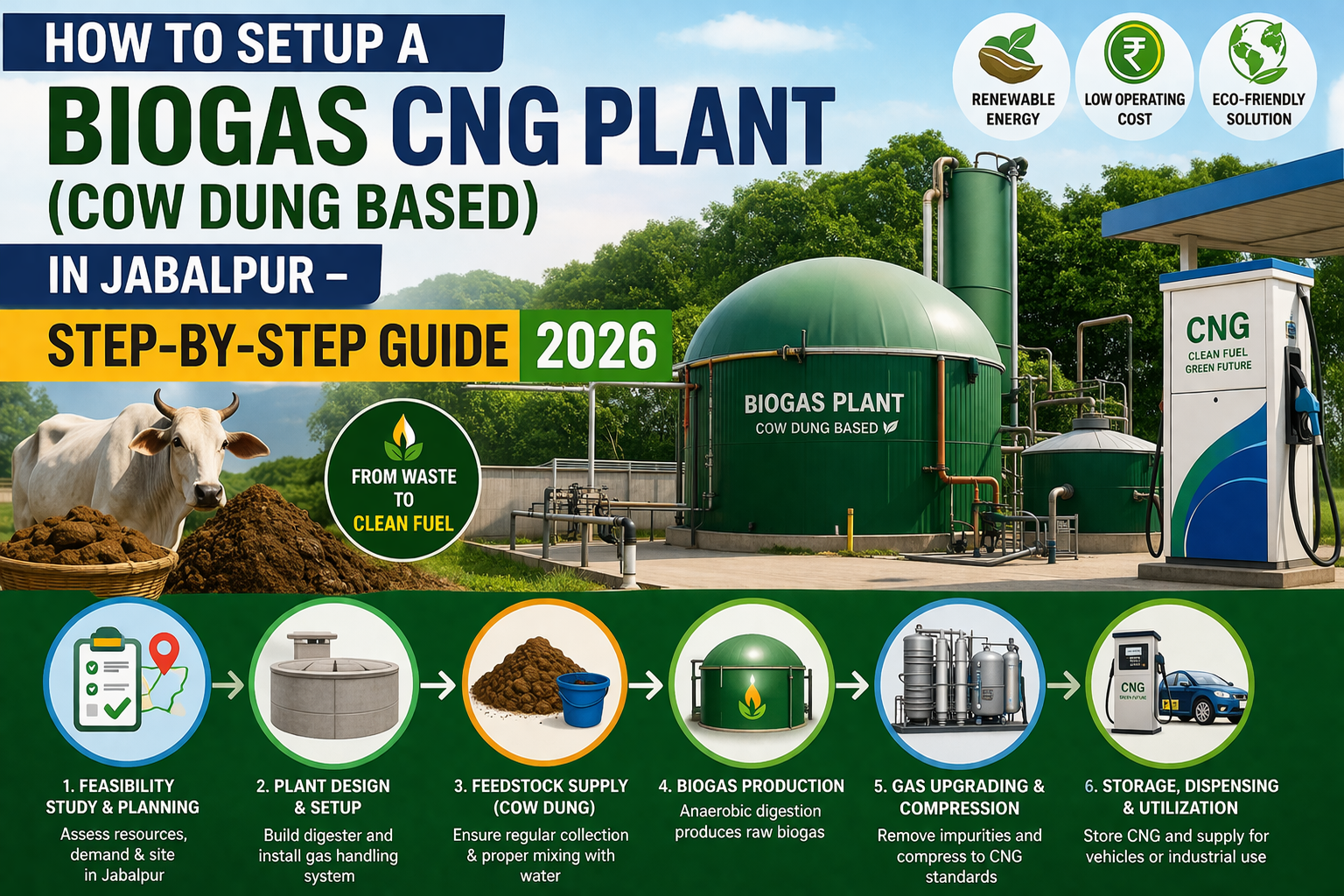
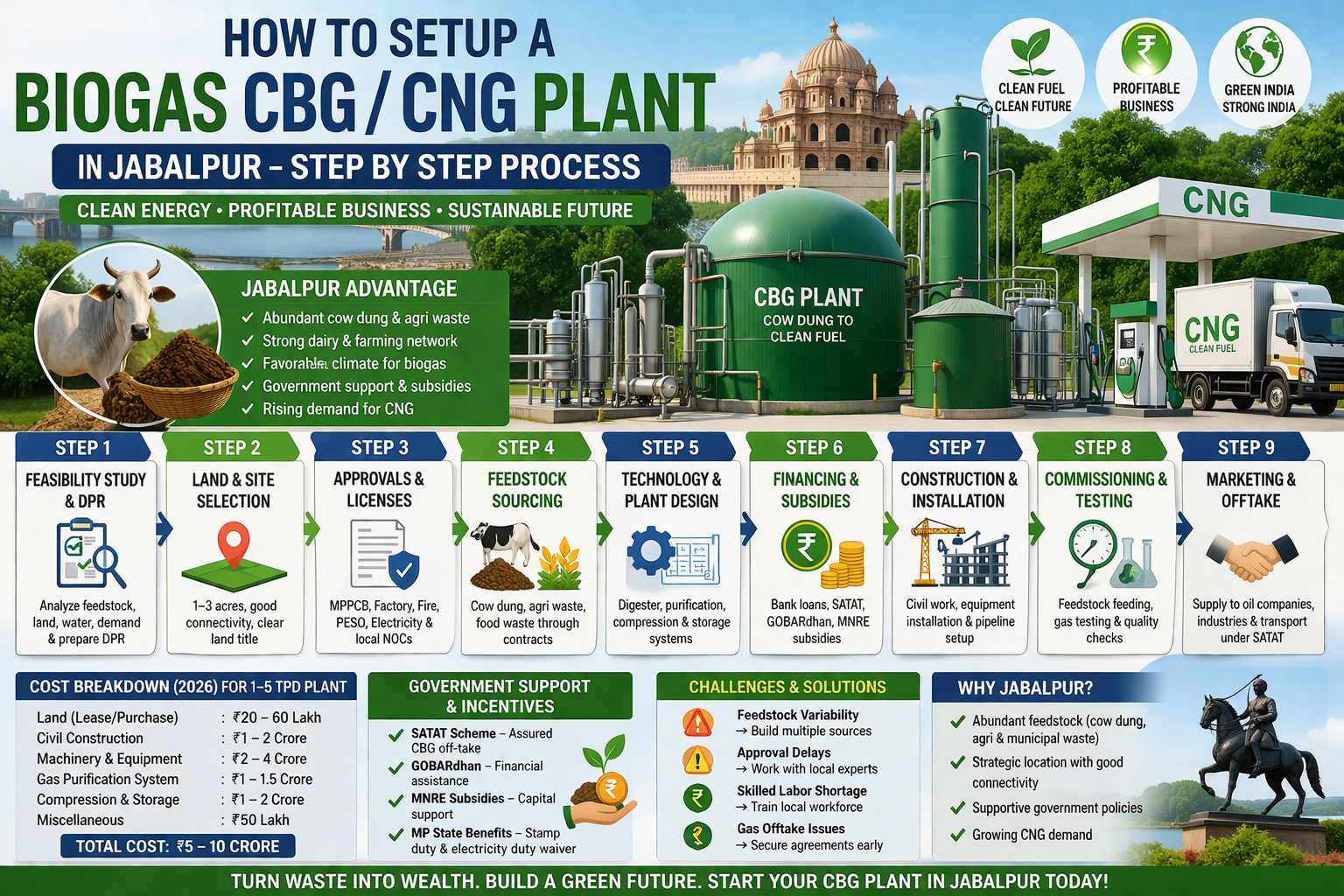
Step-by-Step Process to Setup a Biogas CNG Plant in Jabalpur
1. Feasibility Study & DPR Preparation
- Analyze local dung availability (minimum 20–30 tons/day)
- Conduct site survey in rural Jabalpur
- Prepare Detailed Project Report (DPR)
- Estimate ROI and plant capacity
Tip: Engage a professional consultant for accurate projections.
2. Land Selection & Site Development
- Minimum 1–2 acres land required
- Prefer locations near dairy farms
- Ensure road connectivity and water availability
Checklist:
- Non-agricultural land conversion (if required)
- Distance from residential areas
3. Secure Feedstock Supply (Cow Dung)
- Tie up with local dairy farmers
- Create long-term supply agreements
- Arrange logistics for daily collection
Practical insight: Reliable feedstock is the backbone of your biomethane plant setup.
4. Choose Plant Capacity & Technology
- Small scale: 2–5 TPD
- Medium scale: 10–20 TPD
- Large scale: 50+ TPD
Technology includes:
- Anaerobic digester cow dung system
- Gas purification unit
- Compression system
5. Install Anaerobic Digester System
- Construct digester tanks
- Maintain temperature (35–38°C ideal)
- Ensure proper mixing of dung and water
Timeline: 2–3 months
6. Biogas Purification & Compression
- Remove CO₂, H₂S, and moisture
- Upgrade methane to CBG standards
- Compress gas into cylinders
This stage defines the quality of your biogas purification and compression system.
7. Storage & Bottling Infrastructure
- Install high-pressure cylinders
- Setup cascade system for transport
- Ensure PESO compliance
8. Apply for SATAT Scheme & OMC Tie-Up
- Register under SATAT scheme
- Get Letter of Intent (LOI) from Oil Marketing Companies
- Fix long-term gas purchase agreement
9. Obtain Licenses & Approvals
- Pollution Control Board clearance
- Factory license
- Explosive license (PESO)
- Local municipal approvals
10. Hire Skilled Workforce
- Plant operators
- Technicians
- Maintenance staff
11. Testing & Commissioning
- Trial runs for 30–60 days
- Quality testing of gas output
- System optimization
12. Commercial Operations
- Start gas supply to OMCs
- Sell slurry as organic fertilizer
- Monitor daily production
Required Permissions, Licenses & Government Subsidies in Madhya Pradesh (2026 Updated)
Setting up a biogas CNG plant Jabalpur requires multiple approvals.
Key licenses:
- MP Pollution Control Board (Consent to Establish & Operate)
- PESO certification
- Factory license
- Environmental clearance
Subsidies & schemes:
- SATAT scheme Jabalpur: Assured buyback by OMCs
- GOBARdhan scheme: Financial assistance for waste-to-energy projects
- MNRE subsidies (2025–2026): Capital subsidy for biogas plants
- State-level incentives for renewable energy
These subsidies significantly reduce your biogas plant cost in Jabalpur and improve profitability.
Detailed Cost Breakdown & ROI Calculation for Jabalpur
Here’s a realistic estimate for a medium-scale plant:
Capital Investment:
- Land: ₹20–40 lakh
- Plant & machinery: ₹2.5–4 crore
- Civil construction: ₹50–80 lakh
- Licensing & approvals: ₹10–20 lakh
Total Cost: ₹3.5–5 crore
Revenue Streams:
- CBG sale: ₹45–55/kg
- Organic fertilizer sales
- Carbon credits (emerging market)
Monthly Revenue Estimate:
- ₹25–40 lakh (depending on capacity)
ROI:
- Break-even: 3–5 years
This makes a cow dung biogas CNG plant in Jabalpur a financially attractive investment.
Common Challenges & How to Overcome Them
1. Irregular Feedstock Supply
- Solution: Contract multiple suppliers
2. High Initial Investment
- Solution: Use subsidies and bank financing
3. Technical Failures
- Solution: Choose proven technology providers
4. Skilled Labor Shortage
- Solution: Provide training programs locally
5. Seasonal Variations
- Solution: Maintain slurry consistency and storage
Success Stories / Case Studies from Madhya Pradesh
- Several CBG plant from cow dung projects in Indore and Bhopal are successfully supplying gas under SATAT.
- Small-scale plants in rural MP are generating steady income through fertilizer sales.
These examples prove that the cow dung biogas plant Madhya Pradesh model is already working and scalable.
Future Scope & Profit Potential in Jabalpur
The future of biogas CNG plant Jabalpur projects looks extremely promising.
Growth drivers:
- Rising CNG demand in transportation
- Government push for clean energy
- Expansion of SATAT scheme
- Increasing organic farming demand
Experts predict that the biomethane sector in India will grow rapidly by 2030, making early investors highly profitable.
Conclusion
Setting up a cow dung biogas CNG plant in Jabalpur is not just an environmentally responsible decision—it’s a smart business move for 2026 and beyond. With strong government support, abundant raw materials, and growing demand for clean fuel, Jabalpur offers the perfect ecosystem for success.
If you follow the step-by-step process outlined above—right from feasibility study to commercial operations—you can build a sustainable and profitable venture in the renewable energy space.
Need expert guidance? If you’re planning to start your plant and want help with DPR, approvals, or vendor selection, consider consulting a professional biogas expert to fast-track your success.









Leave a Reply